
TouchDRO Plus Digital Readout App
The TouchDRO Android app is the core of the system: it displays the position readouts and provides the on-screen functions you use at the machine. You can download it from the Google Play Store or the Amazon Appstore.
The app connects over Bluetooth or USB to a TouchDRO scale interface adapter, a compact box that reads your DRO scales and transmits position data to the tablet. Together, they give you a full-featured digital readout (DRO) with standard functions (bolt circles, hole patterns, sub-datums, saved zeros) plus graphical tools that traditional consoles don't offer.
The app comes in two tiers. TouchDRO Plus is included with current-generation TouchDRO adapters and adds the workflow features this page describes; TouchDRO Community is the free tier for DIY builds, third-party hardware, and older TouchDRO adapters.
Where TouchDRO Helps in the Shop
TouchDRO covers the standard DRO functions (unit/mode toggles, bolt circles, sub-datums, tool offsets, axis summing), and the comparison table below covers those feature by feature. Here, let's talk about where TouchDRO helps you get more done, and actually enjoy your time at the machine.
When building TouchDRO Plus, we focused on removing the things that pull your attention away from actually machining: extra screen taps, mental math, tedious setup steps. Fewer distractions, fewer mistakes, more time cutting.
See where you are, not just the numbers
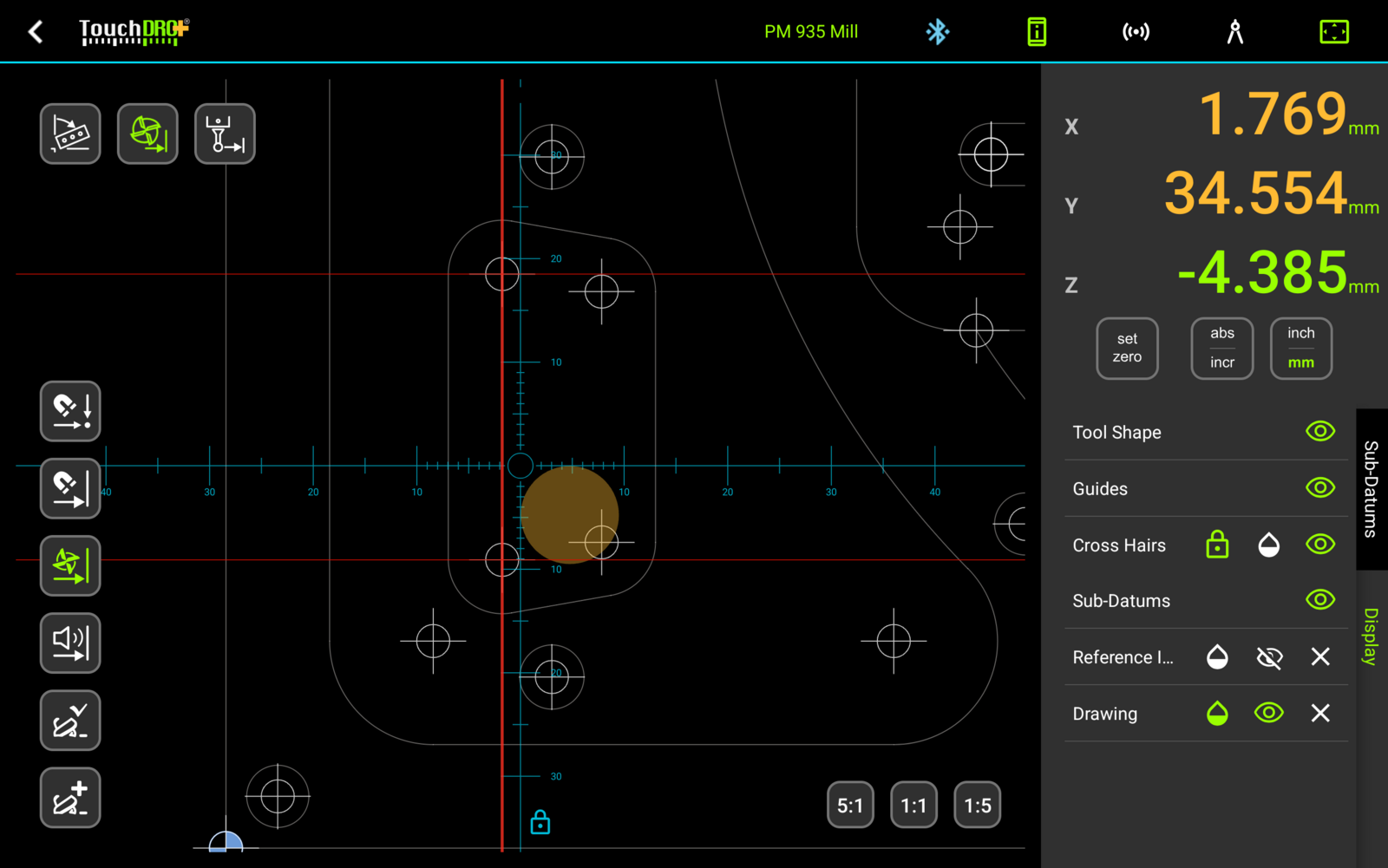
A traditional digital readout shows digits. TouchDRO's Graphical View shows your position on a visual workspace: guide lines, stored coordinates, cutter diameter, and your current location all on screen at once. You can see where you are relative to the part, not just read a number and do the math in your head.
And you don't have to keep tapping the screen to use it. As you move across the workspace, TouchDRO can automatically select the next coordinate as you approach it. For drilling patterns, auto-advance on quill movement steps to the next hole when you raise the quill. You stay focused on the machine, not the tablet.
Find edges and centers without menu diving
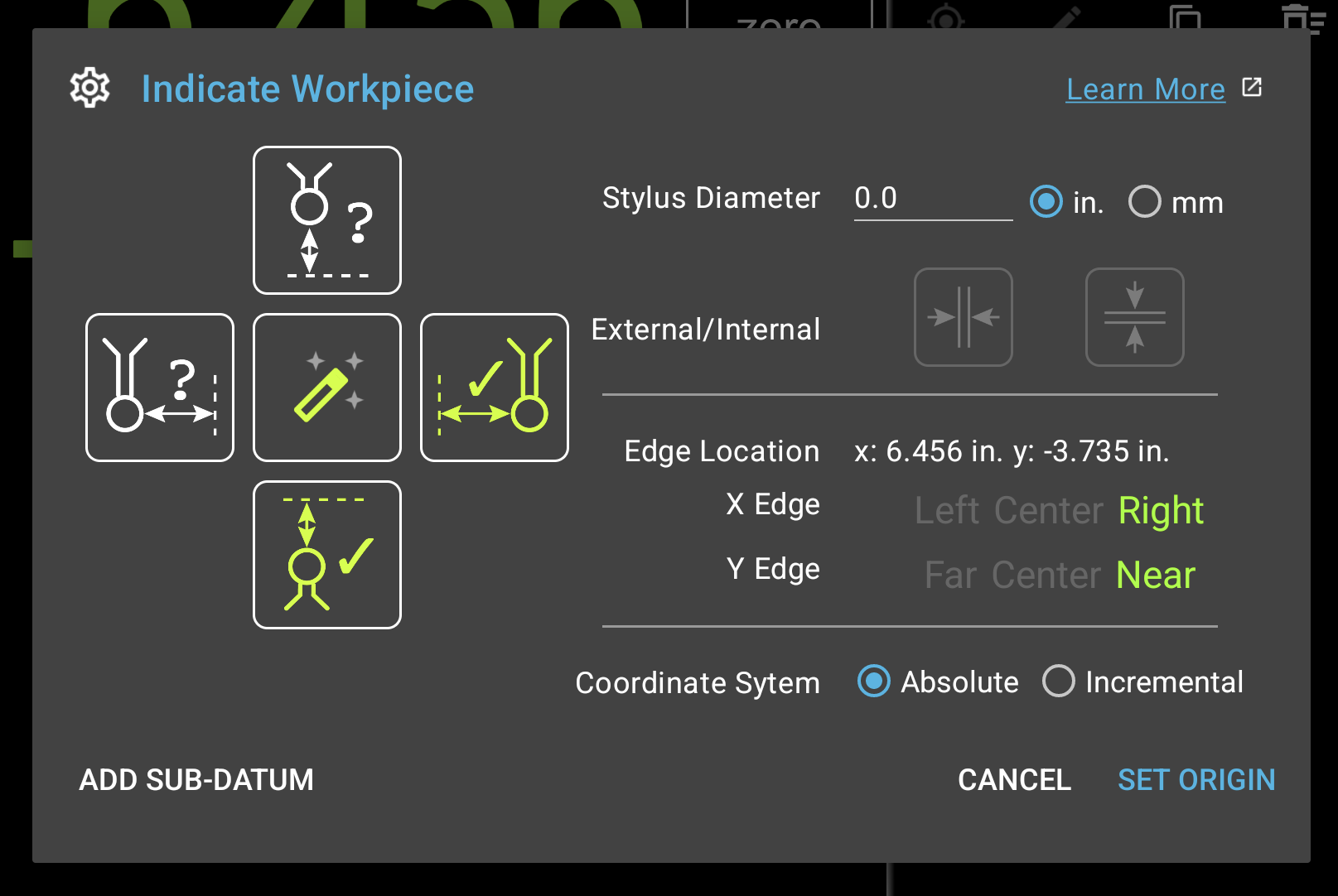
You're probably already using an edge finder or wiggler to pick up your setups. It's not hard; it's just easy to make a mistake. The classic one: "Did I account for the tip radius, and did I add or subtract it this time?"
TouchDRO takes that kind of shop math off your plate. When you use a touch probe, it automatically figures out which edge you're picking up based on the direction you're moving. If you use a mechanical edge finder or wiggler, one tap tells TouchDRO to account for the tool diameter and set the edge.
When you're done, you can drop the result straight into your coordinate list to save the feature location. Less screen tapping, fewer chances to add when you should have subtracted, and a lot more "touch, store, move on."
Measure the part without unclamping it
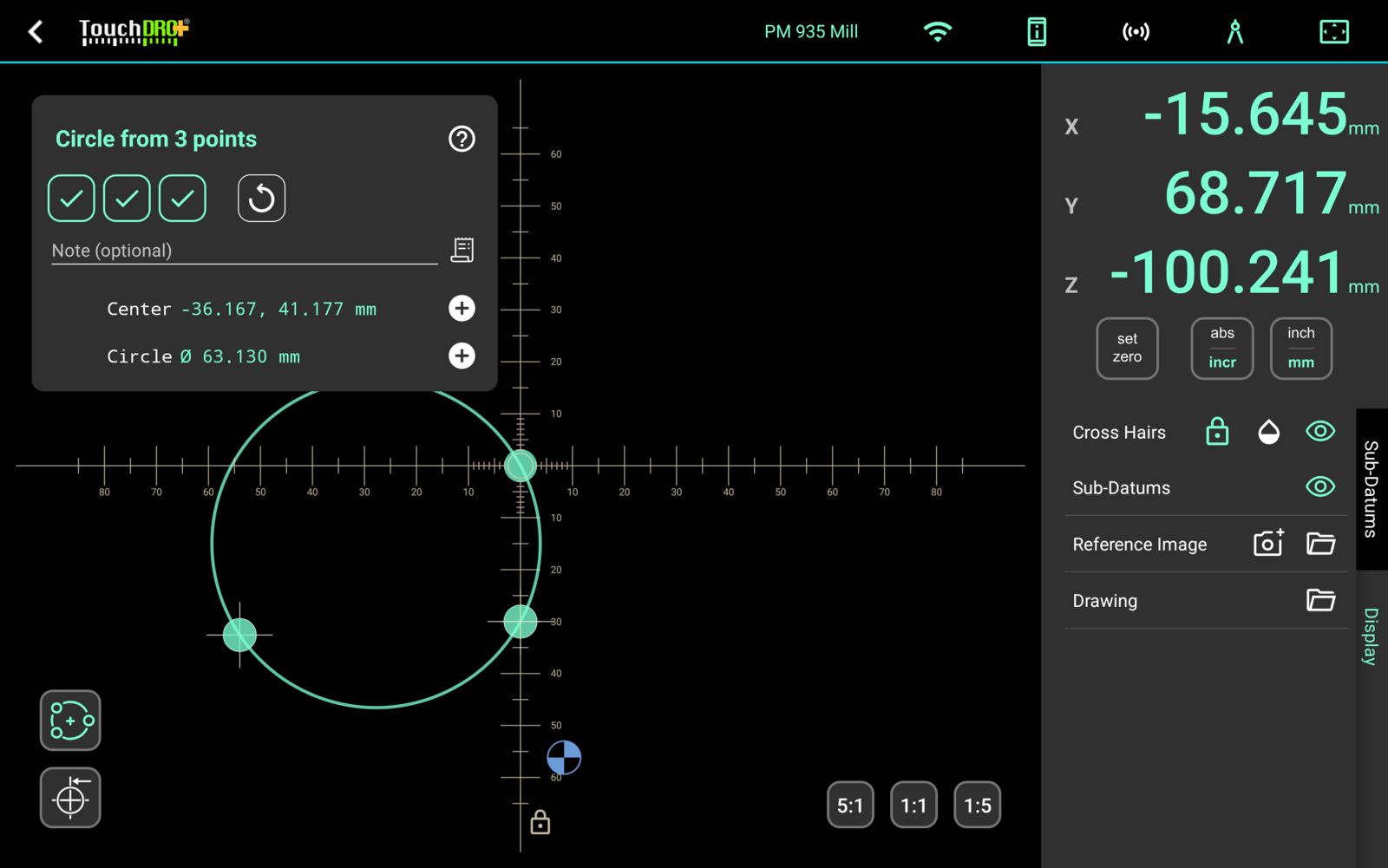
A milling machine with 5μm scales and a cast-iron frame is often the most precise measuring instrument in a small shop. In measurement mode you can put that to work: pick up points on the part with a touch probe or an inexpensive USB microscope, and TouchDRO works out the dimension from them.
For example, some parts are awkward to measure with calipers, or even on a surface plate. You can get the center and diameter of a bore from three points on its wall, the distance between two hole centers, how far an edge runs off square, the angle between two edges, and the corner they would have met at even when the corner has been machined away.
Each result can go into the sub-datum list for the machine to use, into the inspection log with a note, or both.
You can measure a part that is clamped crooked, too. TouchDRO will square the readouts to the part's own edges, so the coordinates follow the part, no matter how it sits in the vise.
Capture and export measured coordinates
Once the features are captured, you can take them off the tablet in whichever format the next step needs. TouchDRO exports the same workspace three ways.
For CAD, export the workspace as a DXF drawing. Open the file in CAD, and every saved point is there to snap to, every circle you measured is a real circle, and your tags become the drawing's layers. This is the path for reverse engineering: probe the hole centers and edges of a part that has no drawing, and draw the mating part over the measured geometry.
For a spreadsheet, export the coordinate list as a CSV file: one row per point, with names, notes, and tags. The same file imports back into another workspace, or onto another tablet.
The inspection log has its own export, as a formatted text report or as a CSV file with one row per measurement. That is the record for repair work, or for checking a print you don't fully trust, and it avoids the "write it down, type it in later, hope you didn't swap a sign" routine.
Work on a rotary table from the print
A hole pattern on a rotary table normally means converting every feature by hand: work out each hole's radius and angle, index the table, and calculate new X and Y positions at every stop. It's tedious, and every conversion is a chance to scrap the part.
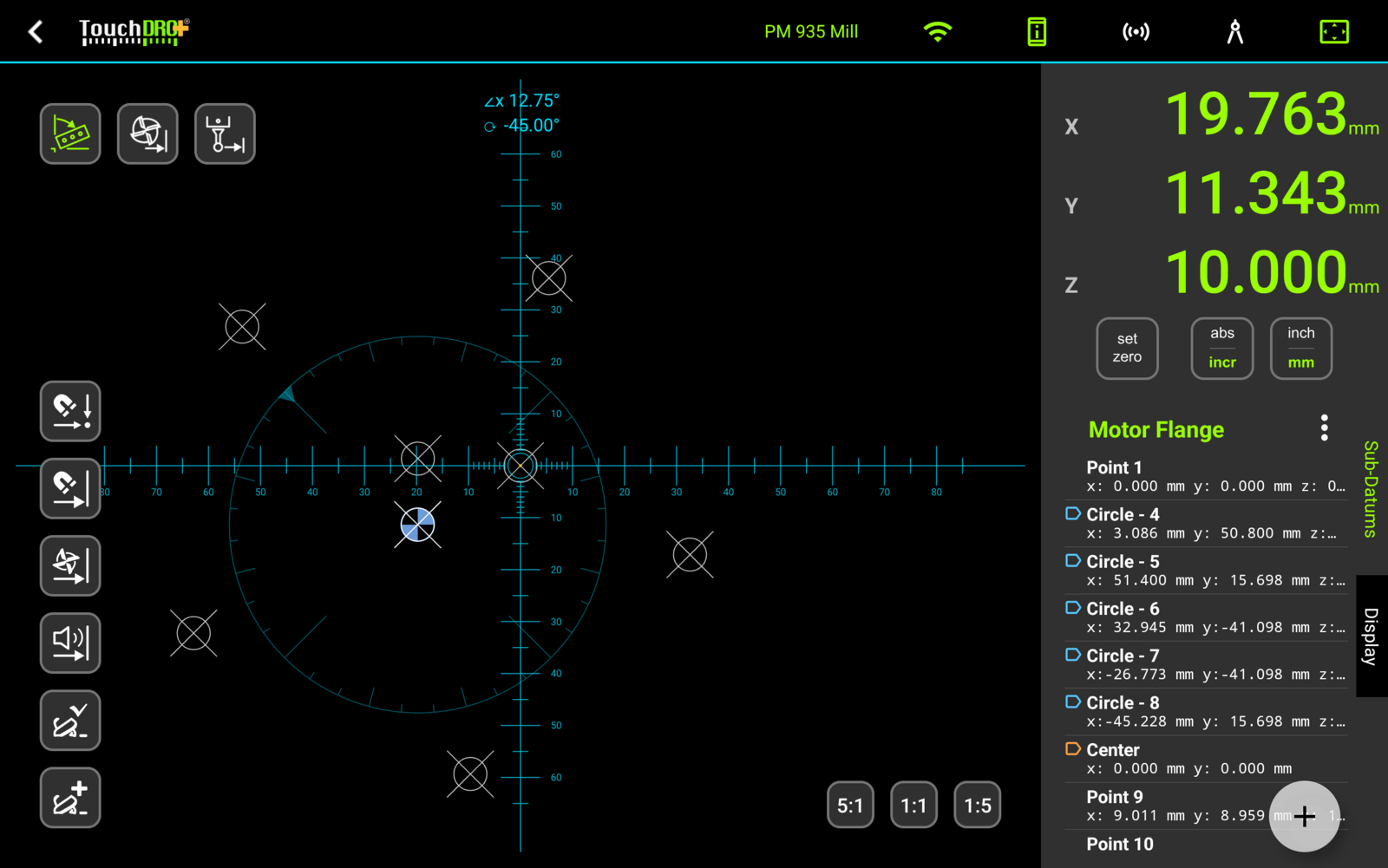
With TouchDRO Plus, you can enter the coordinates straight off the drawing and let the "Rotate Part" function turn the stored geometry with the table. Index to any angle, and every feature is where the print says it is; with an inexpensive encoder on the rotary axis, the geometry follows the table live as you crank it. The same function handles a casting clamped at an odd angle, or a second operation whose datum edge runs off square to the first.
How to use a rotary table with TouchDRO →
Visual Layout Overlays
Graphical View is one of TouchDRO’s most useful tools, and Plus takes it further: put the part itself on the screen, as an imported CAD drawing or as a photo, and machine while watching your position move over it.
Follow a CAD drawing on the screen
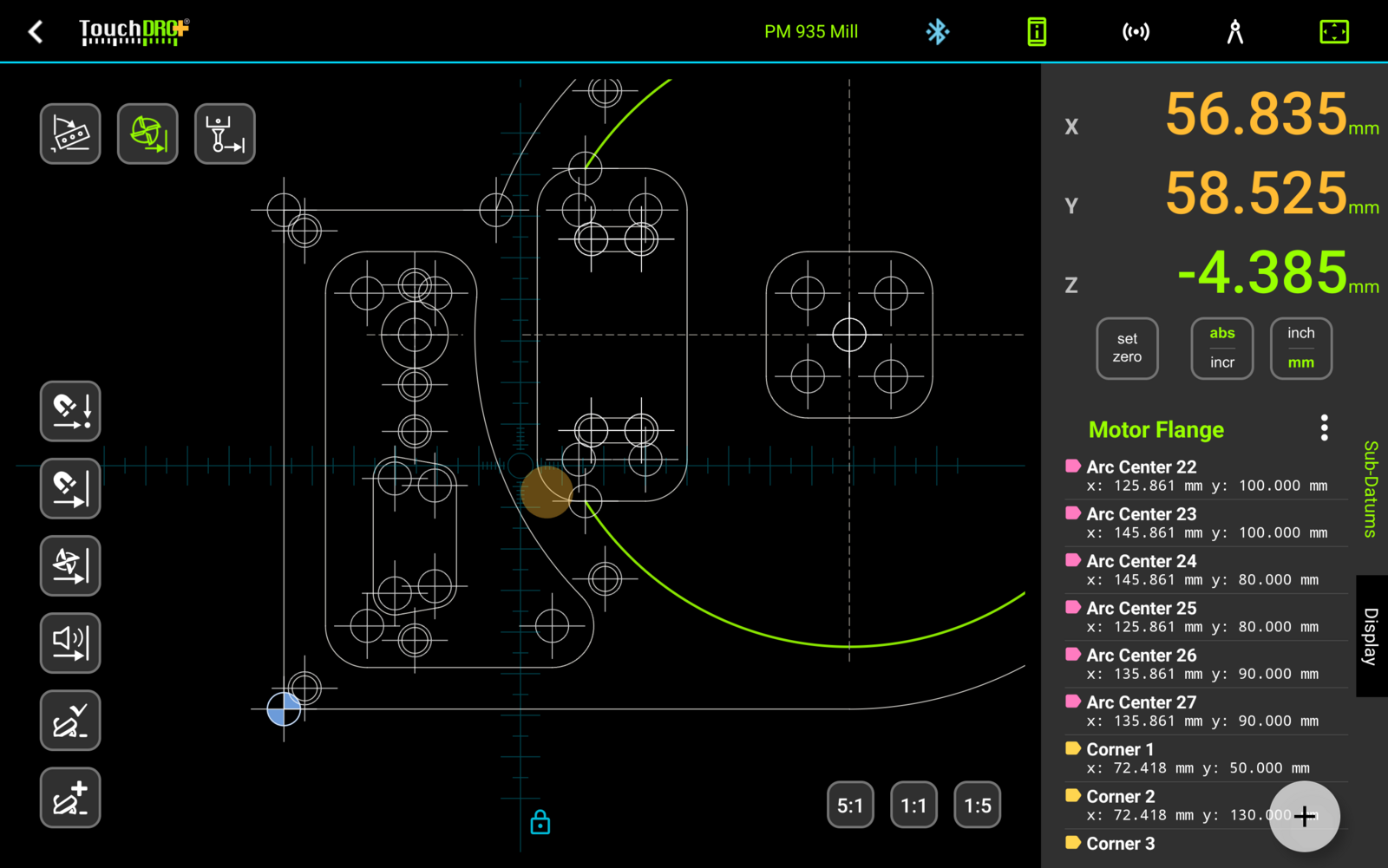
Some shapes are really "CNC parts": rounded gussets, blended radii, profiles that would take forever to lay out by hand. If you don’t have a CNC, the old-school workaround is to print the drawing, glue it to the stock, and machine to the paper.
TouchDRO gives you a cleaner version of that idea. Import the drawing itself. TouchDRO shows it at true scale, in real coordinates, with no calibration step, and the crosshairs show where the spindle is on the part as you crank the handwheels.
TouchDRO can also extract the drawing's hole centers, arc centers, and corners as sub-datums, tagged by group, so every important location is a tap away and a pattern with several hole sizes can be worked one drill size at a time. Right now the way to get a drawing into TouchDRO is through SnapCAD, with direct DXF import coming later.
Use a photo as a quick guide
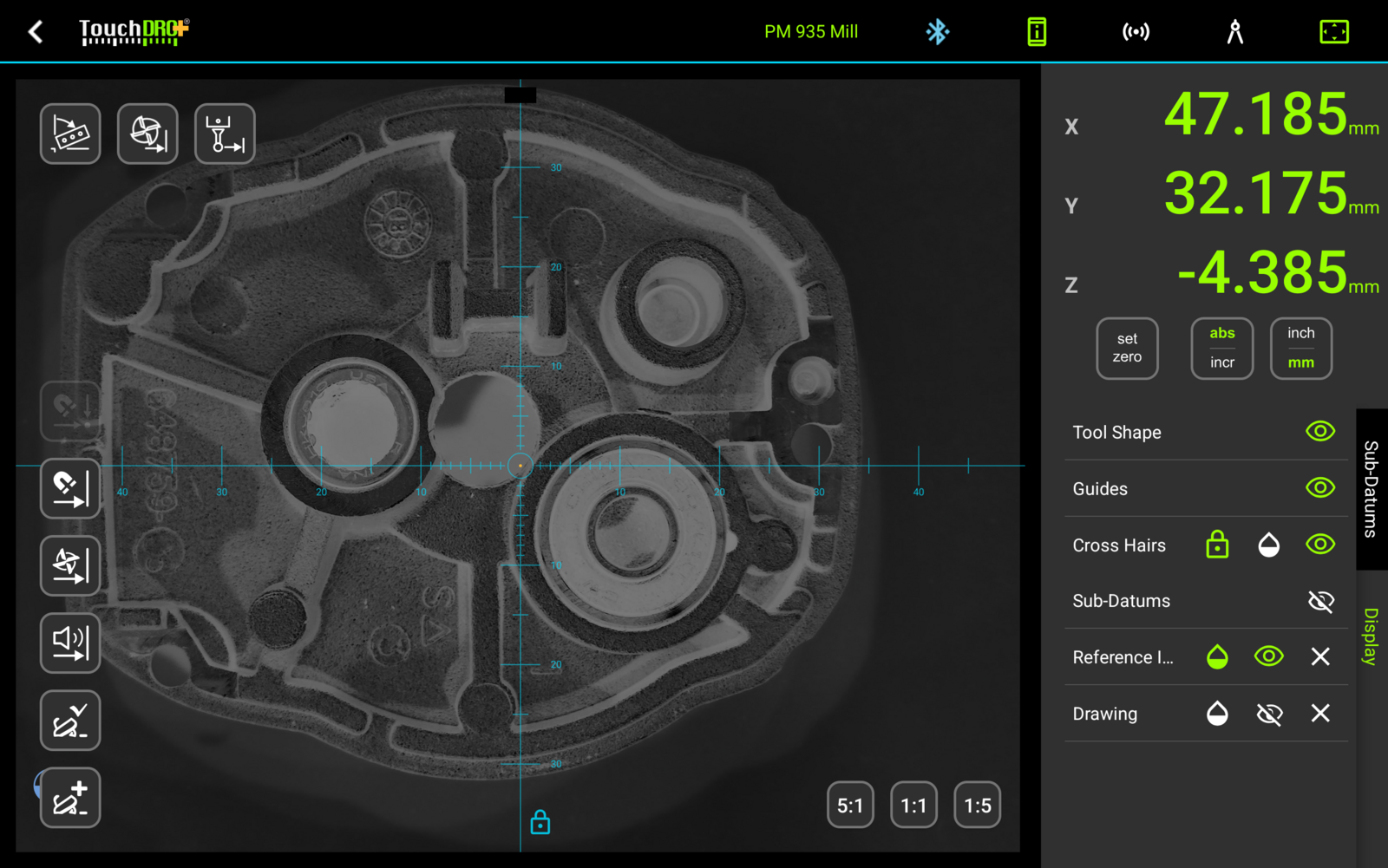
Sometimes you don't have a drawing, just a part. Maybe you're making a mating bracket, matching a profile, or just trying to put holes in the same places as the original.
With TouchDRO Plus, you can snap a photo of the part and use it as a quick layout guide. Pick up a few reference points to line it up to your DRO coordinates, and TouchDRO scales and rotates the image into place. As you move the handwheels, you can see where the spindle is relative to features in the photo, which is useful for roughing in a shape or checking your progress. It's not a substitute for real measurement, but for "get it close" work, it beats dye and scribe.
Keep your hands on the handwheels
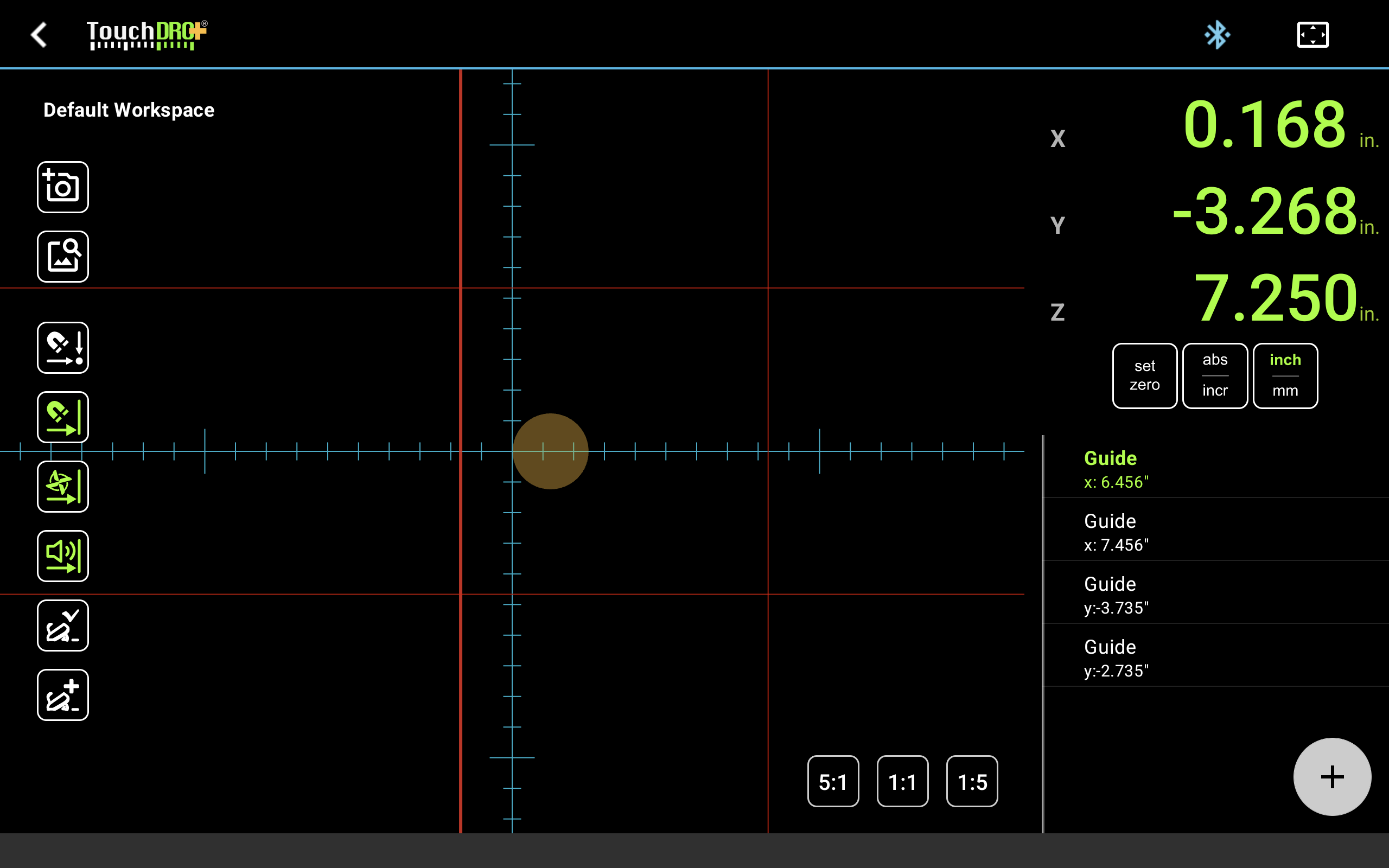
Pockets and slots are where a manual machine starts to feel busy. You're watching the cut, watching backlash, trying not to lose track of which edge you're heading toward. Scribe lines help, until they get wiped out by coolant and chips.
TouchDRO takes much of that mental load off. As you move toward a guide line, it can activate it automatically, set tool offset to the correct side, and beep as you approach the edge. This makes it easier to rough with a safe allowance, then come back and finish to size: no recalculating, no second-guessing which way to compensate. Same idea works on a lathe: an audible cue as you approach a thread relief helps you disengage the half-nut at the same spot every pass.
Plan the job on your PC
Typing a long coordinate list on a tablet, standing at the machine, is slow, and it's where the mistakes that scrap parts happen. With CSV import, you can build your coordinate list at a desk using Excel or Google Sheets: real keyboard, big screen, and the print or drawing right in front of you. Add descriptions, double-check the numbers, then import it into TouchDRO with a few clicks.
In a small shop, that means the next setup can be ready while the machine is still running. In a home shop, it’s the same idea: you’re comfortable, you’re not rushed, and you’re less likely to fat-finger a coordinate.
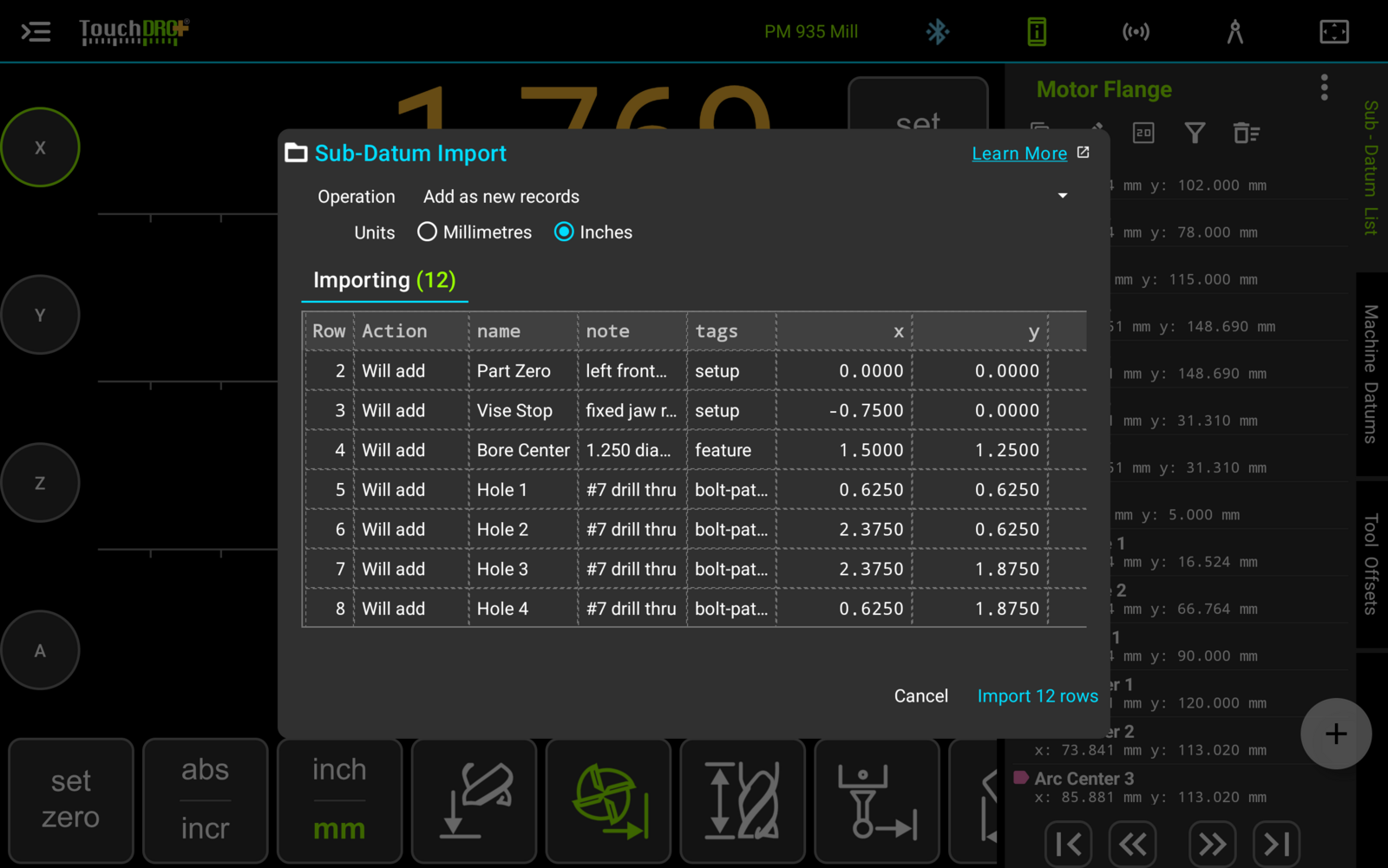
You can fill the mill's tool library the same way: measure your cutters once, put the table together in a spreadsheet, and load the whole set at once.
How to import coordinates from a CSV file →
Correct scale error without an interferometer
Magnetic scales are often the only thing that fits a lathe cross slide or a mini mill table, and their weak spot is non-linear error that normal calibration can't touch. Commercial consoles that support segmented error compensation expect you to measure that error yourself and key the correction table in on a keypad; the traditional alternative is a calibration service with a laser interferometer.
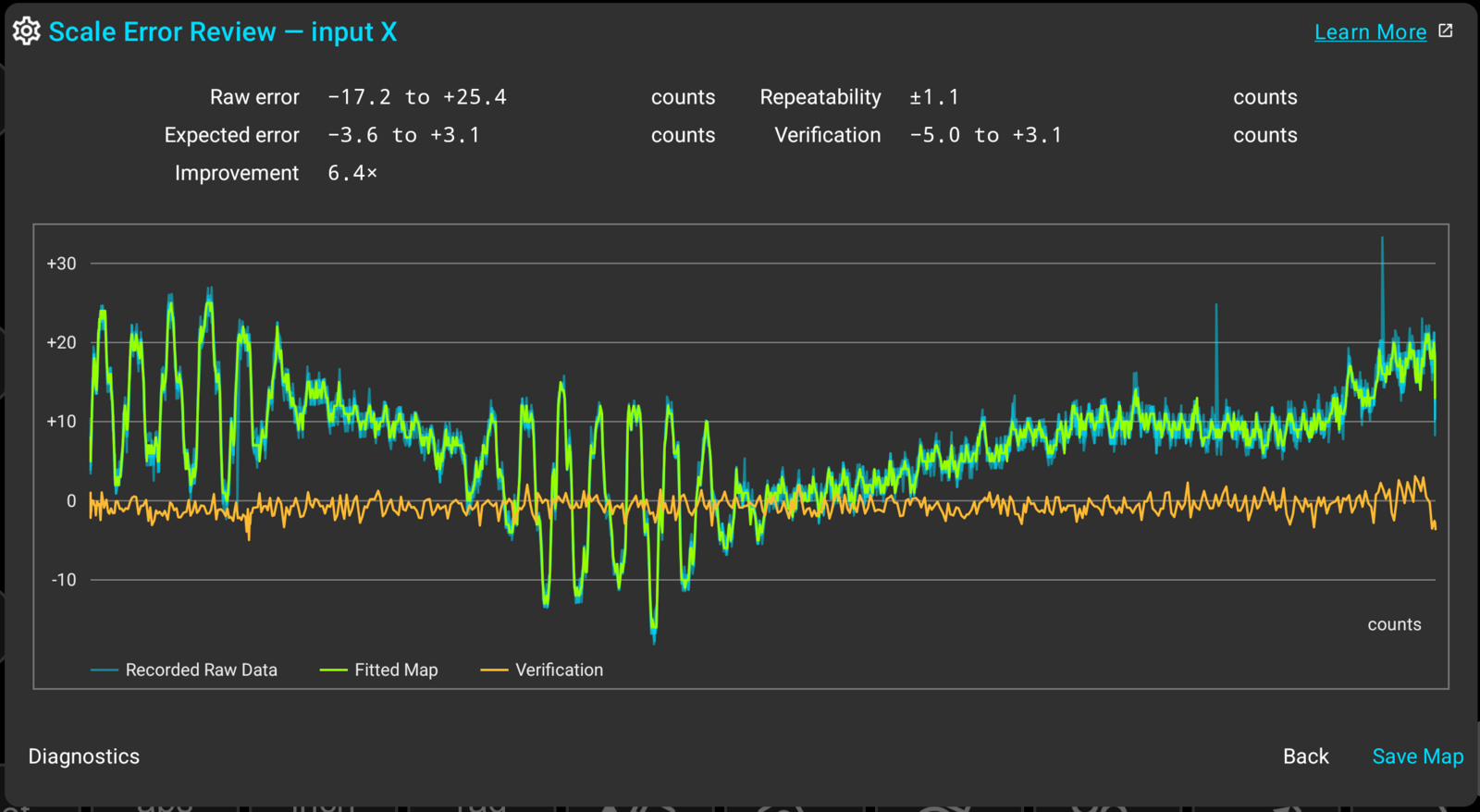
TouchDRO Plus builds the correction map for you. Clamp a known-good scale (a spare glass scale works) parallel to the axis, crank back and forth a few times, and the Error Map Wizard records both scales, computes the map, and shows an honest before-and-after, verified against readings the map has never seen. The budget 1 micron magnetic scale on our shop lathe went from 43 microns of error to single digits: a 6.4× measured improvement. The same recording doubles as a scale accuracy test even if you never save the map.
How we checked and corrected our lathe's magnetic scale →
One tablet, multiple machines
TouchDRO lets you set up separate machine profiles (mill, lathe, surface grinder, whatever you run) and move the same tablet between them. Each profile can also have its own layout: readout precision (0.000 vs 0.00000), which functions show up next to each axis, hidden readouts, and font size. Set it up the way you like to work.
TouchDRO also has dedicated display modes for mills and lathes. For example, on a lathe, many customers add an inexpensive tachometer sensor to see spindle RPM and real-time surface speed (SFM) while they cut. On a mill, you can set cutter radius right from Graphical View, with no menu diving to see where the edge of the cutter actually is.
TouchDRO Plus vs. TouchDRO Community
- TouchDRO Plus: a set of advanced features bundled with all TDA-4xx adapters and the TDK-40 kit (or standalone pre-programmed module). For kits, Plus was originally an add-on option; starting in late 2025, all kits and modules include it. If you're not sure whether you have Plus, connect the adapter and look at the app icon in the top bar; a yellow "+" means it's active.
- TouchDRO Community: the free tier that works with legacy TouchDRO adapters, third-party hardware, and DIY builds. Includes core DRO functionality: readouts, bolt circles, tool offsets, sub-datums, axis summing, and Graphical View.
Feature Comparison
Both tiers share the core digital readout functions. Plus adds the workflow tools that save time on more involved setups. Hover a feature name for a short description, or follow "Learn more" for the manual page.
| TouchDRO Community | TouchDRO Plus | |
|---|---|---|
| Core DRO Functions | ||
| Mill (Horizontal or Vertical) and Lathe Display Modes Learn more | Yes | |
| Bolt Circle, Arc, and Grid Patterns Learn more | Yes | |
| Sub-Datum (Saved Coordinate) Memory Learn more | Yes | |
| Cutter Radius and Height Compensation (Mill) Cutter radius Tool height | Yes | |
| Tool Offset Compensation (Lathe) Learn more | Yes | |
| Spindle RPM and Surface Speed Display Learn more | Yes | |
| Near-Zero Audible Warning Learn more | Yes | |
| Graphical View and Automation | ||
| Graphical View Workspace Learn more | Yes | |
| Guide Lines Learn more | Yes | |
| CAD Drawing Import * Learn more | No | Yes |
| Photo and CAD Image Overlays Learn more | No | Yes |
| Automatic Guide Activation and Tool Offset Direction Learn more | No | Yes |
| Auto-Advance Through Stored Coordinates Learn more | No | Yes |
| Rotary Table Support * Learn more | No | Yes |
| Probing and Edge Finding | ||
| Touch Probe and Edge Finder Support Learn more | Yes | |
| Automatic Edge Detection Learn more | No | Yes |
| Save Probed Points to the Sub-Datum List Learn more | No | Yes |
| Probe Tip Diameter Calibration * Learn more | No | Yes |
| Camera and Microscope Edge Finding * Learn more | No | Yes |
| Measurement and Inspection | ||
| Measurement Mode * Learn more | No | Yes |
| Measuring Bore Centers, Distances and Angles * Learn more | No | Yes |
| Measuring a Part Clamped at an Angle * Learn more | No | Yes |
| Inspection Log * Learn more | No | Yes |
| Inspection Log Text and CSV Export * Learn more | No | Yes |
| Profiles and Libraries | ||
| Machine Profiles * Learn more | Yes | |
| Adapter Profiles * Learn more | Yes | |
| Probe Profiles * Learn more | Yes | |
| Tool Library: Cutter Radius and Height Offsets Learn more | Yes | |
| Data Import and Export | ||
| Import Coordinates from a CSV File Learn more | No | Yes |
| Export Coordinates to a CSV File Learn more | No | Yes |
| Export Coordinates and Digitized Geometry as DXF * Learn more | No | Yes |
| Machine Profile Settings Import/Export Learn more | Yes | |
| Adapter Profile Import/Export * Learn more | Yes | |
| Probe Profile Import/Export * Learn more | Yes | |
| Tool Library Import/Export Learn more | Yes | |
| Live Data Streaming over TCP and MQTT * Learn more | No | Yes |
| Accuracy and Compensation | ||
| Linear Error Compensation Learn more | Yes | |
| Hysteresis Compensation Learn more | Yes | |
| Backlash Compensation, Constant * Learn more | Yes | |
| Error Correction and Backlash Maps * Learn more | No | Yes |
| Head Angle Compensation (Mill) * Learn more | No | Yes |
| Compound Slide Angle Compensation (Lathe) * Learn more | No | Yes |
* Requires TouchDRO version 3.30.00 or later. That version is currently available through the open beta track; the TouchDRO V3 page explains how to join.
Feature Documentation
If you want step-by-step instructions (screens, buttons, and setup), these manual pages go into the details:
- Graphical View Display
- CAD Drawing Import
- Reference Image Overlay
- Working with Guides
- Near-Zero Warning
- Sub-Datum Memory
- The Sub-Datum Panel
- Sub-Datum Tags and Filtering
- Workspaces and Coordinate Entry
- Edge Finder Function
- Probe Profiles and Tip Calibration
- Measurement Mode
- Measurement Functions and the Inspection Log
- Exporting a Workspace to DXF
- Measuring a Part Clamped at an Angle
- Using a Rotary Table
- Mill Tool Library
- Error Correction and Backlash Maps
- Creating an Error Map
- Machine Profiles
How to Get TouchDRO Plus
TouchDRO Plus is included with current-generation TouchDRO hardware, so there is nothing extra to buy:
- TouchDRO Adapter for Milling Machines (TDA-420), which includes touch probe/tool setter inputs and works with most glass/magnetic scales.
- TouchDRO Adapter for Lathes (TDA-410)
- DIY TouchDRO Kit (TDK-40)
- Pre-programmed module for the DIY kit
Upgrading from V2 hardware
If you have a second-generation (V2) TouchDRO adapter for glass/magnetic scales, there’s a paid firmware upgrade to V3.
DIY or third-party compatible hardware
If you built your own adapter (or you’re using third-party compatible hardware), TouchDRO’s core DRO features work the same way. TouchDRO Plus features require TouchDRO hardware that includes the Plus key.
If you have older TouchDRO hardware, there may be upgrade options (see the V2 upgrade above). If your adapter can’t be upgraded and you purchased it directly from our store, ask us about trade-in credit. Contact us.
How Plus shows up in the app
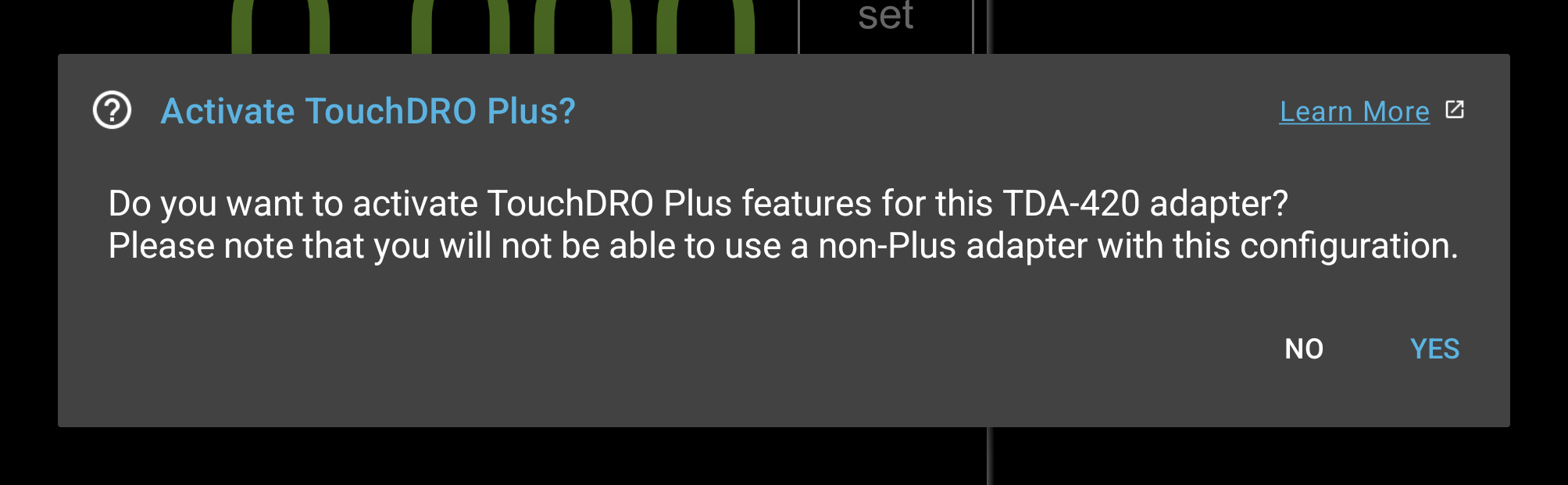
Connect a Plus-enabled adapter and TouchDRO will ask if you want to enable Plus for that machine profile. Tap "Yes" and you're set: a yellow Plus icon appears in the top bar, and the Plus-only controls show up where you'd expect. No subscription, no internet required.
Frequently Asked Questions
[Expand]Do I need to pay extra for TouchDRO Plus?
No. TouchDRO Plus is included with current-generation TouchDRO hardware; there’s no separate purchase and no subscription.
Does TouchDRO Plus require an internet connection?
No. TouchDRO Plus is designed for an offline-first shop setup. Once you have the adapter, Plus works without Wi-Fi, without a monthly check-in, and without “phoning home.”
Which adapter do I need if I want to use a touch probe?
You’ll need the DRO for Milling Machines (TDA-420). It’s the only current adapter with touch probe inputs.
I have glass/magnetic (quadrature) scales. Does the TDA-420 work with them?
Yes. The TDA-420 is designed for mills and supports optical/magnetic scales (quadrature), and it also supports select capacitive scale systems with the appropriate input converters.
If I buy a Plus-enabled adapter, can I use Plus with my existing (older/DIY/compatible) adapters too?
Not on the same machine profile. Plus features are tied to the adapter that contains the Plus key. If you plug in a non-Plus adapter, TouchDRO runs as TouchDRO Community for that adapter; so, create a separate machine profile for each adapter you use.
Can I use TouchDRO Plus with a DIY or third-party compatible adapter?
DIY/third-party compatible adapters can run TouchDRO’s core DRO functions. TouchDRO Plus features require TouchDRO hardware that includes the built-in Plus key.
What if I have older TouchDRO hardware?
If you have a V2 TouchDRO adapter for glass/magnetic scales, there’s a paid firmware upgrade to V3. If your older TouchDRO hardware can’t be upgraded and you purchased it directly from our store, ask us about trade-in credit. Contact us.
Does the CAD/photo overlay “snap” to geometry or auto-pick points from the drawing?
No. The overlay is a visual reference that you align to your DRO using a few reference points. TouchDRO does not infer snap points or extract geometry from the image.
What data does TouchDRO Plus send back to you?
None for normal use. TouchDRO Plus is intended to run fully offline in the shop, and it doesn’t require a cloud connection or background data collection to keep working.
Ready to Get Started?
TouchDRO Plus comes with current-generation TouchDRO hardware: connect the adapter, and your digital readout does everything described on this page.