
Using Mitutoyo Scales with TouchDRO
Mitutoyo AT2, AT11, AT211, AT103, and similar DRO scales show up on used milling machines and lathes, often with the original console dead or missing. The scales themselves tend to outlast the console electronics; even 30-plus-year-old AT2 or AT11 scales in good condition can perform very well and can be worth keeping. More modern AT100 or AT200 scales will likely be better than a fresh budget import. You don't need to spend Mitutoyo money on a new DRO or try to find a working legacy console.
Some Mitutoyo scales connect with only an adapter cable, some need a signal converter, and some use proprietary protocols that are not currently supported. This page will help you identify which type you have, what signal it outputs, and whether it can be used with TouchDRO.
Mitutoyo Scales and Connectors at a Glance
Mitutoyo's older scales used a few different connector types that mapped cleanly to the signal type and supply voltage. For example, scales that used a 7-pin bayonet connector were 10V sin/cos scales, and scales that used a 6-pin bayonet connector were 5V quadrature/TTL. In contrast, most of their modern AT scales use a 15-pin D-Sub connector, regardless of the signal type.
| Scale Family | Signal | TouchDRO Compatible? | What You Need |
|---|---|---|---|
| Digimatic Instruments with 5-pin flat SPC connector | Digimatic / SPC serial | Yes | SPC converter with Mitutoyo 905338 (1m) or 905409 (2m) cable |
| Digimatic Instruments with 6-pin round SPC connector | Digimatic / SPC serial | Yes | SPC converter with Mitutoyo 937387 (1m) or 965013 (2m) cable |
| 572 Series (9-pin D-Sub connector) | Digimatic / SPC serial | Not Yet Supported | Digimatic-to-quadrature converter (in development, not yet available) |
| AT200 Series | RS-422 differential TTL quadrature | Yes | DB15-to-DB9 adapter cable |
| AT100 Series | 2 Vpp pseudo-differential sin/cos | Not Yet Supported | Sin/cos-to-quadrature converter (in development, not yet available) |
| AT500 / AT715 Series | Proprietary serial (RS-485 physical) | Not Supported | Contact us if you need this |
| AT2-N / AT11-N (6-pin round connector) | 5V TTL quadrature | Yes | 6-pin Mitutoyo adapter cable |
| AT2-FN / AT11-FN (7-pin round connector) | 4 Vpp sin/cos (10V supply) | Not Yet Supported | Sin/cos-to-quadrature converter (in development, not yet available) |
Digimatic / SPC Scales
Digimatic (also called SPC) is Mitutoyo's serial data protocol for handheld measurement instruments. The protocol is the same across calipers, micrometers, indicators, quill scales, and 572-series linear scales; only the physical connector and the supply voltage change between product lines. The signals are open-drain rather than standard TTL, so a Digimatic device can't be wired into a typical DRO input directly. The physical hookup to TouchDRO is different for each product line and is covered in the subsections below.
5-Pin Digimatic (Modern SPC Instruments)
The 5-pin flat Digimatic connector is the standard data port on current-production Mitutoyo handheld instruments (calipers, micrometers, indicators, and the popular 053906B quill scale). The connector is sealed and proprietary, so the only practical way to read one is with a Mitutoyo-made data cable.

To connect a 5-pin Digimatic instrument to TouchDRO, use a Mitutoyo SPC data cable, part number 905338 (1m) or 905409 (2m), between the instrument and the Mitutoyo SPC converter. The converter reads the Digimatic protocol and outputs a signal the TouchDRO adapter can read. The adapter input the converter plugs into has to be switched from its default "Quadrature A/B" mode to "Mitutoyo SPC" in the Adapter Details dialog, followed by an adapter restart, before the instrument will read.
6-Pin Round Digimatic (Older Instruments)
Older Mitutoyo Digimatic instruments use a 6-pin round connector instead of the flat 5-pin SPC plug. Electrically and protocol-wise these are the same as the modern 5-pin instruments; only the physical connector is different.

The 6-pin Digimatic connector is also Mitutoyo-proprietary, so it needs a dedicated Mitutoyo cable. Use part number 937387 (1m) or 965013 (2m) between the instrument and the Mitutoyo SPC converter.
DB9 Digimatic (572-Series Linear Scales)
The Mitutoyo 572-series are full-length linear scales designed to pair with Mitutoyo's own Digimatic counter unit. Despite the DB9 connector, the protocol on the wire is the same Digimatic serial format used by the handheld instruments, not RS-422 quadrature. That makes the DB9 pinout incompatible with the Acu-Rite-style DB9 used by most modern DROs, and a straight DB9-to-DB9 cable will not work.

The 572-series scales are not yet supported by TouchDRO. A Digimatic-to-quadrature converter for these scales is in development, but it is not available yet, and we don't have a release date. The pinout is included below for reference.

| DB9 Pin | Signal |
|---|---|
| 1 | Data |
| 2 | Request |
| 3 | Clock |
| 4 | +1.5V |
| 5 | 0V / Signal Ground |
| 6 | +5V |
| 7, 8 | Shield |
| 9 | N.C. |
Modern AT DRO Scales (DB15)
The current generation of Mitutoyo AT scales uses a DB15 connector regardless of what the scale outputs electrically. This is the single most common source of confusion with Mitutoyo: the same connector is shared across three incompatible electrical families. Always verify which model you have before wiring. The DB15 alone doesn't tell you whether the scale is sending quadrature, sin/cos, or a proprietary serial stream.
AT200 Series (Quadrature)
AT200 series scales (AT203, AT211, and similar) output a quadrature signal (differential RS-422) and run on a 5V supply. TouchDRO supports that signal natively. You can either swap the scale's DB15 connector for a DB9 male, or use a pre-made adapter cable. Either way, the scale's reference mark still works, so TouchDRO can re-establish absolute position after a power cycle.

The AT200 DB15 pinout is as follows:

| DB15 Pin | Signal |
|---|---|
| 1, 2, 13 | 0V / Signal Ground |
| 3, 4, 11 | +5V |
| 5 | Channel A |
| 6 | Channel A (inverted) |
| 7 | Channel B |
| 8 | Channel B (inverted) |
| 9 | Reference (index) |
| 10 | Reference (inverted) |
| 15 | Frame Ground / Shield |
If you connect the scale directly by replacing its connector, wire every +5V lead to TouchDRO's 5V pin and every ground lead to its 0V pin. AT200 scales carry two or three +5V leads. All of them have to be connected, or the scale won't work correctly.
AT100 Series (Sin/Cos)
AT100 series scales (AT103, AT112-F, AT113, AT116, AT181, and similar) output a pseudo-differential analog sin/cos signal. It is similar to the more common 1 Vpp sin/cos output, but the wiring is different. Instead of two complementary pairs, these scales use a single sin line and a single cos line at 2 Vpp nominal amplitude, plus a shared common-mode reference line.


| DB15 Pin | Signal |
|---|---|
| 1, 2 | 0V / Signal Ground |
| 3, 4 | +5V |
| 5 | Sin/Cos A |
| 6 | Sin/Cos B |
| 7 | Vref |
| 8 | R (Reference) |
| 15 | Frame Ground / Shield |
TouchDRO doesn't support sin/cos scales directly, so AT100 and AT400 series scales are not yet supported. A sin/cos-to-quadrature converter for these scales is in development, but it is not available yet, and we don't have a release date.
AT500 / AT715 (Proprietary Serial)
The AT500 series is Mitutoyo's current absolute-position magnetic-scale line; AT715 is the previous-generation equivalent in the same family. Both use a proprietary serial protocol over a half-duplex RS-485 physical layer (twisted pair). TouchDRO does not support these scales yet. Please contact us if you'd like to use AT500 or AT715 scales with TouchDRO. Knowing there's demand helps us prioritize what to support next.
AT500 and AT715 scales are not currently supported by TouchDRO. The pinout is included below for identification.

| DB15 Pin | Signal |
|---|---|
| 1, 2 | 0V / Signal Ground |
| 3, 4 | +5V |
| 10 | Data |
| 11 | Data (inverted) |
| 15 | Frame Ground / Shield |
ST Series Scales
Mitutoyo also makes a parallel family of ST (Separate Type, as opposed to Assembly Type) scales. ST scales mostly show up on coordinate measuring machines and metrology equipment rather than shop machine tools, and we haven't tested them ourselves. The pinouts below come from Mitutoyo's documentation, so verify them against your own scale before wiring. ST scales use several Type pinouts (A, B, C, and D), set by a letter in the model number, so matching your variant to the correct pinout matters.
Type B and Type C output a differential quadrature signal, which TouchDRO supports directly. They use a 15-pin D-Sub connector and a 5V supply, but the pinout differs from the AT200 series, so an AT200 cable won't work. We don't offer a ready-made adapter cable for ST scales, so you will need a connector swap or a DIY adapter cable.
| DB15 Pin | Signal |
|---|---|
| 1, 2 | 0V / Signal Ground |
| 3, 4 | +5V |
| 10 | Channel A |
| 11 | Channel A (inverted) |
| 12 | Channel B |
| 13 | Channel B (inverted) |
| 8 | Reference (index) |
| 14 | Reference (inverted) |
| 15 | Frame Ground / Shield |
Type A and Type D output sin/cos only, so they will need the sin/cos-to-quadrature converter that is in development. Type A is single-ended 2 Vpp and shares the AT100 series pinout, so the same converter will handle it the same way. Type D is differential 1 Vpp and uses a different pinout.
| Signal | Type A (DB15 Pin) | Type D (DB15 Pin) |
|---|---|---|
| 0V / Signal Ground | 1, 2 | 12, 13, 15 |
| +5V | 3, 4 | 4, 5 |
| Sin/Cos A | 5 | 9 |
| Sin/Cos A (inverted) | N/A | 1 |
| Sin/Cos B | 6 | 10 |
| Sin/Cos B (inverted) | N/A | 2 |
| Reference (index) | 8 | 3 |
| Reference (inverted) | N/A | 11 |
| Vref | 7, 10 | N/A |
| Frame Ground / Shield | 15 | N/A |
Legacy AT2 and AT11 Scales
Before standardizing on the DB15 connector, Mitutoyo used proprietary Hirose circular connectors for the AT2 and AT11 DRO scales, as well as for many microscope and optical-comparator micrometer heads. Scales with the -N suffix used a 6-pin connector and output a single-ended quadrature signal on a 5V supply. Scales with the -FN suffix used a 7-pin connector and output a pseudo-differential sin/cos signal at 4 Vpp amplitude on a 10V supply.
AT2-N / AT11-N (6-Pin Round Connector)
The AT2-N and AT11-N use a 6-pin Hirose RM12xxx-6P round bayonet connector. They run on a 5V supply and output a TTL quadrature signal (with or without a reference line, depending on the scale model). Electrically these scales are close to modern TTL quadrature scales, so they only need a connector swap or an adapter cable to work with TouchDRO.
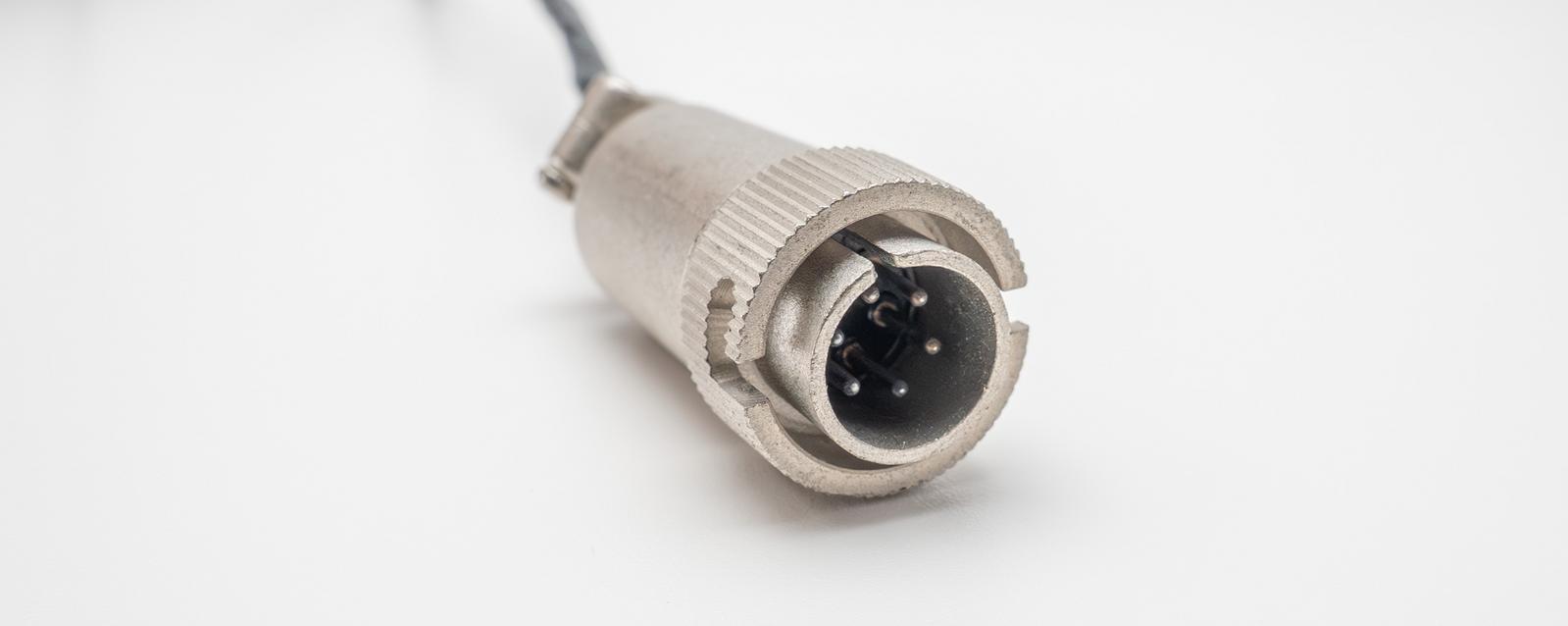
We sell a pre-made 6-pin Mitutoyo scale adapter cable that mates the scale's Hirose RM12 connector to a DB9 plug compatible with the TouchDRO TDA-410/420 adapter or DIY kit. If you'd rather build your own or swap the connector directly, follow the pinout below.
The pinout for the 6-pin AT2-N / AT11-N connector is as follows:
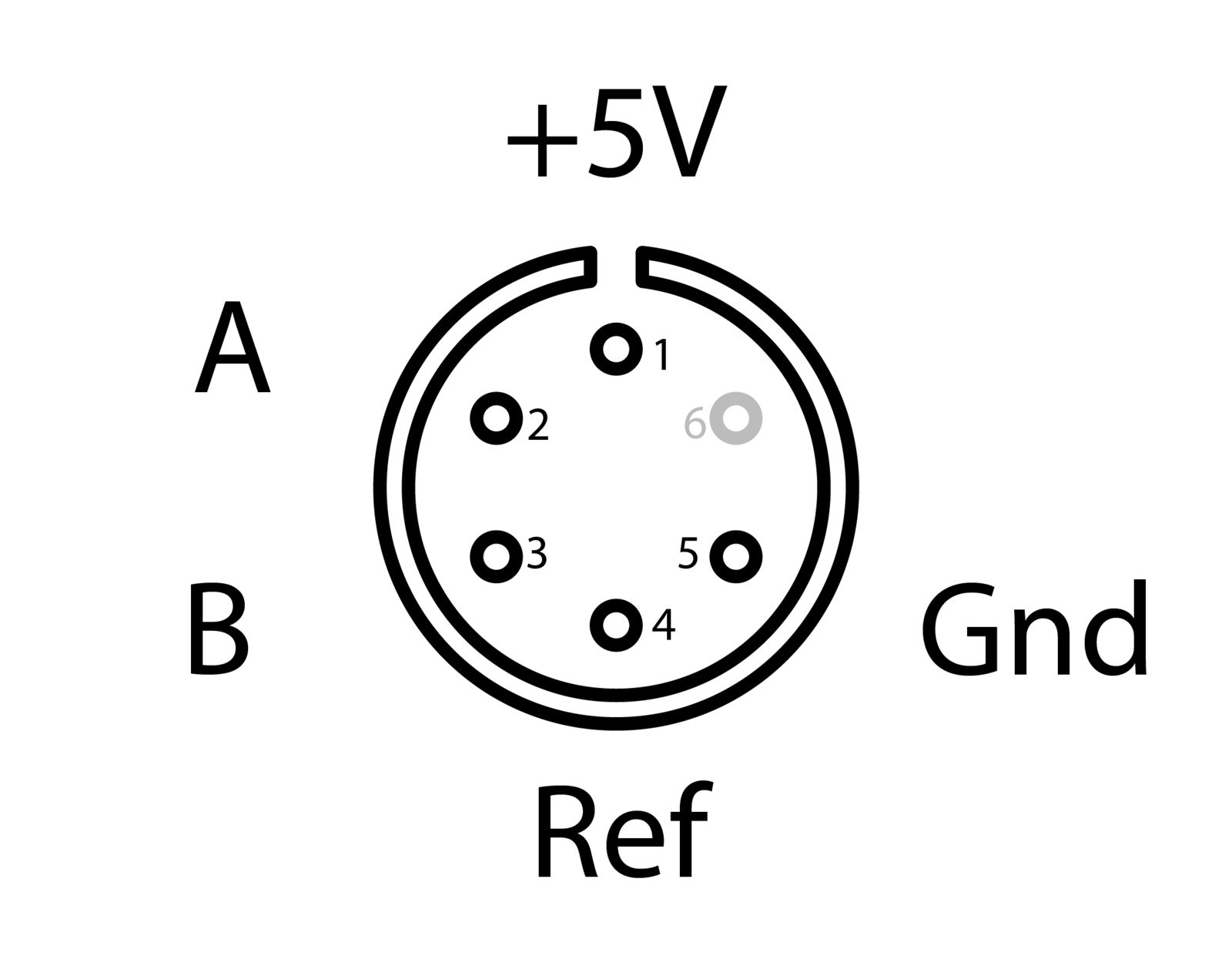
| Pin | Signal |
|---|---|
| 1 | +5V |
| 2 | Channel A |
| 3 | Channel B |
| 4 | Reference (ABS) |
| 5 | 0V / Signal Ground |
| 6 | N.C. |
AT2-FN / AT11-FN (7-Pin Round Connector)
The AT2-FN and AT11-FN are the analog cousins of the -N scales. They use a 7-pin Hirose RM12xxx-7P round bayonet connector, run on a 10V supply, and output a pseudo-differential sin/cos signal at 4 Vpp amplitude.
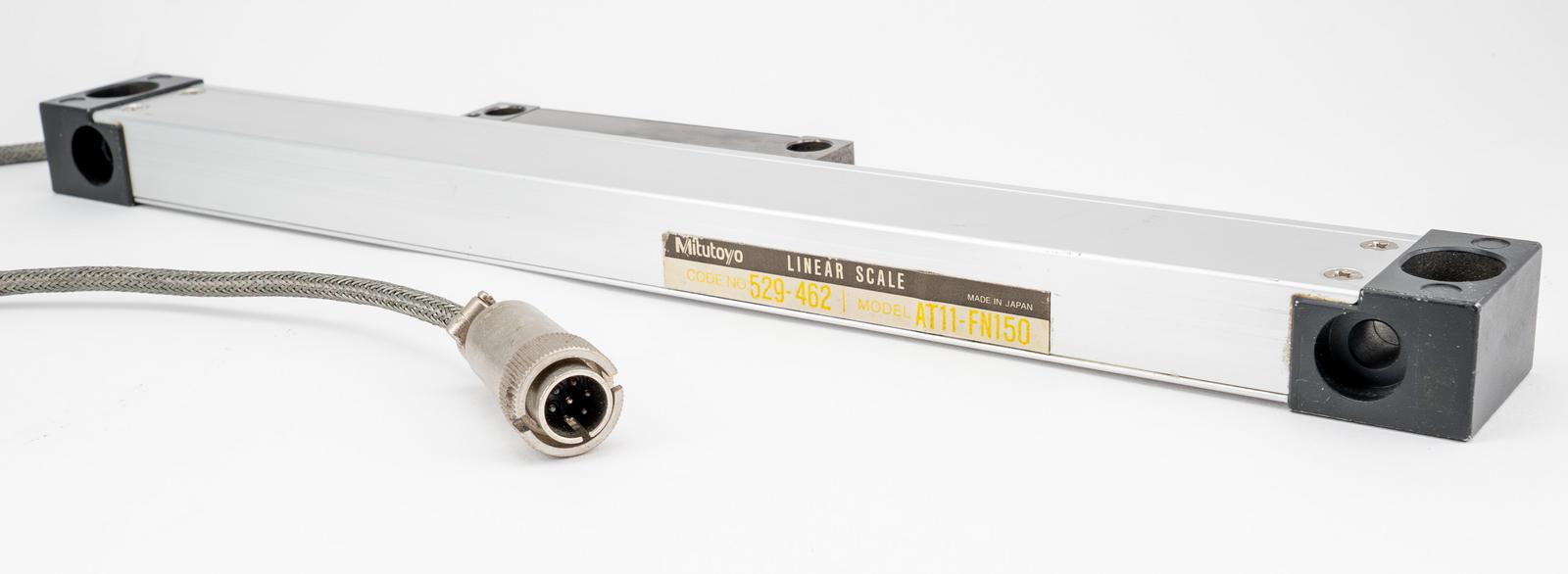
AT2-FN and AT11-FN scales are not yet supported by TouchDRO. The same sin/cos-to-quadrature converter that is in development for the AT100 series will cover these scales as well, but it is not available yet, and we don't have a release date. The pinout is included below for identification.
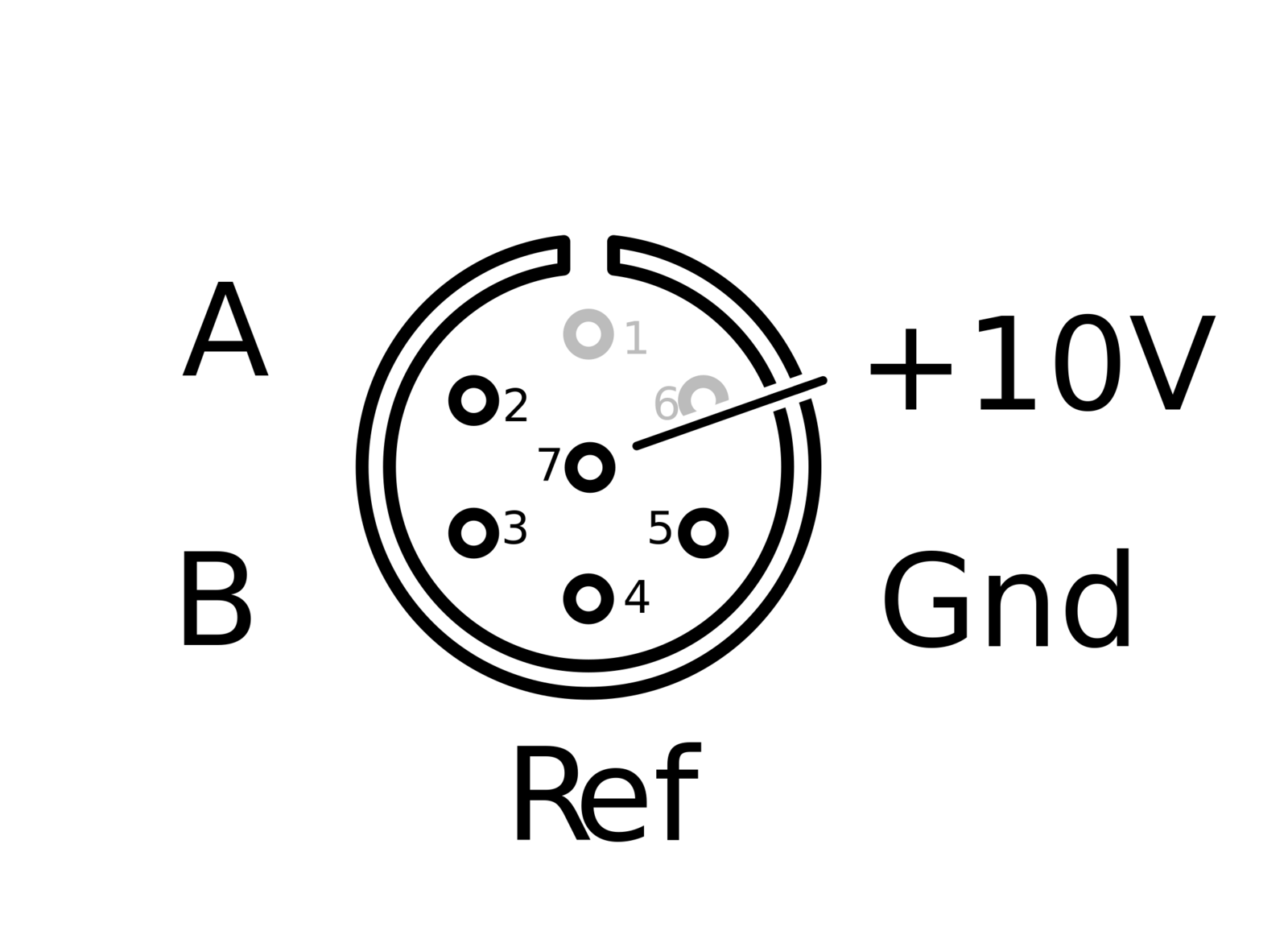
| Pin | Signal |
|---|---|
| 1 | N.C. |
| 2 | Channel A (sin) |
| 3 | Channel B (cos) |
| 4 | Reference (ABS) |
| 5 | 0V / Signal Ground |
| 6 | N.C. |
| 7 | +10V |
Common Wiring Notes
- Verify the pinout and supply voltage before powering anything up. Wrong +5V/0V mapping can damage a scale instantly, and AT2-FN/AT11-FN scales run on a +10V supply.
- The same DB15 connector is shared across AT2xx (TTL quadrature), AT1xx (sin/cos), and AT500/AT715 (serial); the connector alone tells you nothing about what's on the pins, so always confirm the model before wiring.
- Be careful when swapping cables. Mitutoyo cables for different families often share a connector while carrying entirely different signals, so a cable built for one model can misroute power or signals on another; match the cable to the exact model, not just the connector.
- For RS-422 quadrature (AT2xx), each A/A′, B/B′, and Z/Z′ pair should stay on a twisted pair inside the adapter cable, with shielding bonded at one end.
- Several Mitutoyo connectors duplicate +5V and 0V across multiple pins. The pins are not always tied together inside the scale; tie them on the cable side.
Frequently Asked Questions
[Expand]The connector on my Mitutoyo scale doesn't look like any of the connectors on this page. What is it?
Mitutoyo supplies scales to many CMM, optical comparator, and other measurement-equipment manufacturers, and those often use OEM-specific connectors or pigtail harnesses that won't match anything shown here. To pin down the wiring you usually have to work backward from the equipment the scale was originally fitted to. Send us a photo of the scale, its label, and the connector and we'll help you identify it.
How do I tell which signal type my Mitutoyo DB15 scale uses?
You can't tell from the connector; Mitutoyo uses the same DB15 across three incompatible signal families, so you have to identify the model. AT2xx scales (AT203, AT211, and similar) output RS-422 differential TTL quadrature; AT1xx scales (AT103, AT113, AT112-F, AT181) output 2 Vpp single-ended sin/cos; AT500 and AT715 use a proprietary absolute serial protocol. The model number is usually etched or printed on the scale body. Check it against the tables on this page before wiring, because a quadrature input, a sin/cos input, and a serial scale are not interchangeable.
I have a non-Mitutoyo scale with a similar round connector. Will it work?
Don't assume it will. Hirose is a major connector manufacturer and the RM12 series was widely used, so plenty of other equipment makers fitted the same connector, with no guarantee the pinout or electrical characteristics match Mitutoyo's. A matching connector tells you nothing about what's on the pins; identify the scale and verify its pinout and signal type before wiring anything.
I have a Mitutoyo micrometer head with a 6-pin connector. Is it the same pinout as the AT2-N / AT11-N scales?
Yes. Mitutoyo's 6-pin round-connector micrometer heads use the same Hirose RM12 6-pin pinout as the AT2-N / AT11-N scales and output the same 5 V TTL quadrature, so the wiring approach is identical.
Can I use a Mitutoyo scale with a DRO other than TouchDRO?
It depends on the scale's signal type. Quadrature scales (AT2xx, and the legacy AT2-N / AT11-N) output a standard signal and work with any DRO that accepts 5V TTL or RS-422 quadrature, provided the pinout matches. Sin/cos scales (AT1xx) need a sin/cos-to-quadrature converter first; ours is still in development, and third-party interpolators exist. Digimatic / SPC scales are the exception: decoding that protocol is uncommon outside Mitutoyo's own counters, so most general-purpose DROs can't read them. The absolute AT500 / AT715 scales use a proprietary serial protocol that isn't supported by TouchDRO or, as far as we know, other aftermarket DROs.
What resolution will I get from a sin/cos scale with TouchDRO?
The sin/cos converter we have in development reads the scale through a 1:1 zero-crossing comparator, which yields four counts per grating period. The effective resolution comes out to one-quarter of the scale's native grating pitch, so a 20 μm sin/cos scale gives an effective resolution of 5 μm.
What should I do with scale wires that don't map to a TouchDRO input pin?
Leave them unconnected, but isolate each bare end individually with heat-shrink or tape. An unterminated wire that shorts against another pin or the connector housing can damage the scale, so don't just leave them loose inside the shell.
Not Sure What You Have?
If you can't identify your scale, or the connector doesn't match anything on this page, please contact us with a photo of the scale label and the connector. Mitutoyo's lineup is large enough that even after years of collecting pinouts, we still see new variants now and then.